Selecting the right material is one of the most critical decisions in the compression spring manufacturing process. Compression spring materials affect everything from spring performance and life span to corrosion resistance, cost, and compliance with application-specific standards. At Wermke Spring, we offer a broad range of high-quality materials to meet the unique demands of your industry, environment, and mechanical requirements.
This guide explains the most commonly used materials in compression spring manufacturing, along with their mechanical properties, benefits, drawbacks, and typical applications. To learn more or request a quote for your spring manufacturing needs, contact us today.
Why Compression Spring Material Selection Matters
The choice of spring material impacts:
- Load and deflection performance
- Operating temperature range
- Fatigue resistance
- Corrosion resistance
- Electrical conductivity
- Magnetic properties
- Cost and availability
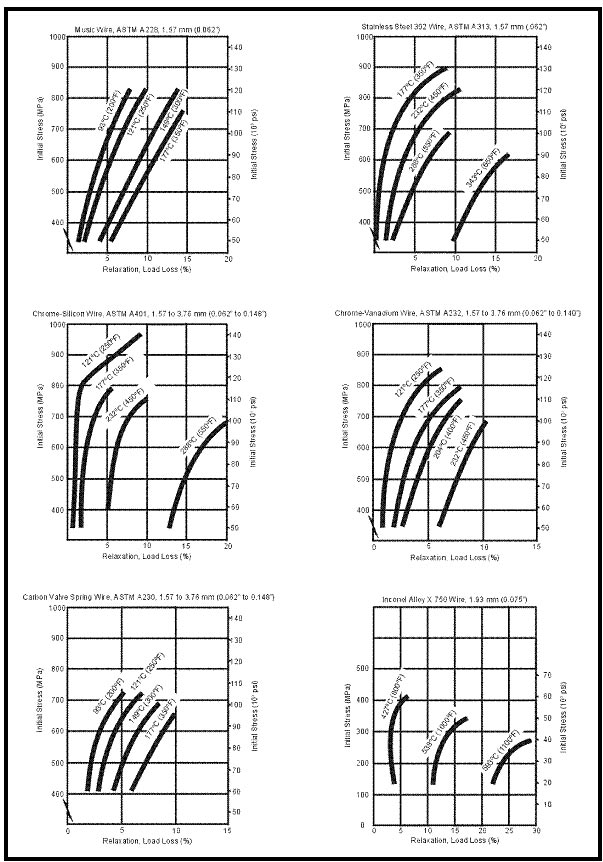
Spring Relaxation Data for Various Materials
Different industries – such as automotive, aerospace, medical, and industrial manufacturing -require different spring characteristics. By understanding material options and trade-offs, engineers can optimize performance and longevity.
Common Compression Spring Materials
1. Music Wire ASTM A228
Music wire is one of the most commonly used spring steels due to its high tensile strength and cost-effectiveness. It’s drawn to precise diameters and delivers consistent mechanical properties.
Pros:
- High strength and elasticity
- Excellent fatigue life under static conditions
- Readily available and economical
Cons:
- Poor corrosion resistance
- Not suitable for elevated temperatures (limit ~250°F / 121°C)
Applications:
- Static or indoor-use springs
- Industrial tools and machinery
- General-purpose compression springs
Learn more about Music Wire Compression Springs
2. Chrome Silicon ASTM A401
Chrome silicon is a high-strength alloy used in applications involving high stress, cyclic loading, or elevated temperatures.
Pros:
- Excellent fatigue resistance
- Withstands temperatures up to 475°F (246°C)
- Good for shock and impact loads
Cons:
- Moderate corrosion resistance (coating recommended)
- Slightly more expensive than music wire
Applications:
- Automotive suspension and valve springs
- Aerospace and heavy-duty equipment
- High-performance compression springs
3. Stainless Steel (302/304) ASTM A313
Stainless steel is widely used in environments requiring corrosion resistance, such as marine, medical, and food processing applications.
Pros:
- Good corrosion resistance
- Non-magnetic in annealed condition
- Withstands moderately high temperatures (~500°F / 260°C)
Cons:
- Lower strength compared to music wire
- Reduced fatigue life under dynamic loads
Applications:
- Outdoor and wet environments
- Medical devices and diagnostic equipment
- Food processing machinery
4. 17-7 Stainless Steel
This precipitation-hardened stainless alloy offers a better combination of corrosion resistance and high tensile strength than standard stainless steel, making it an ideal compression spring material for many applications.
Pros:
- Higher strength and fatigue resistance than 302
- Maintains performance at higher temperatures (~650°F / 343°C)
- Good corrosion resistance
Cons:
- More expensive than standard stainless
- Requires aging heat treatment
Applications:
- Aerospace springs
- Military hardware
- Instrumentation and electronics
5. Oil Tempered Wire ASTM A229
Oil tempered spring wire is a general-purpose carbon steel material that is heat treated and drawn through oil baths to achieve strength and flexibility.
Pros:
- Cost-effective
- Good fatigue properties for moderate loads
- Widely available
Cons:
- Limited corrosion resistance
- Not suitable for high-temperature applications
Applications:
- Garage door springs
- Agricultural equipment
- Industrial tools and machinery
6. Hard Drawn Wire
Hard drawn spring wire is an untempered, cold-drawn carbon steel. It is the most economical compression spring material option but with the lowest fatigue life.
Pros:
- Very low cost
- Suitable for low-stress or static applications
Cons:
- Limited fatigue and temperature resistance
- Susceptible to corrosion
Applications:
- Prototypes and non-critical springs
- Static mechanical components

Specialty Spring Materials Available
In addition to the above, Wermke Spring also manufactures compression springs using specialty alloys for highly demanding environments:
- Inconel – Extreme heat resistance for aerospace and turbine systems
- Elgiloy® – Corrosion and fatigue resistance for high-stress medical and aerospace applications
- Beryllium Copper – Excellent electrical conductivity and non-magnetic properties
- Phosphor Bronze – Corrosion resistance and conductivity for electronics
Our material experts will help you choose the best alloy based on application-specific stress, environmental exposure, regulatory needs, and mechanical performance. For additional information, check out the Spring Wire Properties Tables or the Spring Wire Specification Cross Reference List.
Frequently Asked Questions About Spring Materials
What is the best compression spring material for outdoor environments?
Stainless steel (302 or 316) is an excellent choice for corrosion resistance. For high stress and exposure to saltwater, Inconel or Elgiloy® may be required.
Which spring material offers the best fatigue resistance?
Chrome silicon and 17-7 stainless steel provide superior fatigue life for high-cycle or high-load applications. Material treatment and surface finish also influence fatigue strength.
Can you help me select the right spring material?
Absolutely. Our engineering team will evaluate your application’s requirements and guide you toward the ideal material for performance, cost, and durability.
Do you offer certifications for your spring materials?
Yes. We provide full traceability, certifications, and material data sheets for customers who require documentation for quality control, defense, aerospace, or regulated industries.
Material Considerations in Spring Design
In addition to choosing the correct metal alloy, Wermke Spring considers factors such as:
- Operating temperature range
- Corrosive or chemical exposure
- Stress levels and cycling frequency
- Magnetic or electrical requirements
- Plating, coating, or passivation needs
Our team uses advanced modeling and decades of hands-on experience to deliver springs optimized for your application’s exact needs.
Trust Wermke Spring for Compression Spring Materials and Manufacturing
With over 70 years in business, Wermke Spring is a trusted source for high-quality compression springs built from premium materials. We supply springs for Fortune 500 manufacturers, small machine shops, and everything in between. Our dedication to precision, material knowledge, and responsive customer service sets us apart.
Whether you’re working on a medical device, aerospace system, industrial tool, or consumer product, we’ll help you choose the ideal material and deliver springs that meet your exact performance and environmental requirements.
Contact Us to Get Started
Ready to find the best compression spring materials for your application? Call Wermke Spring at (636) 677-5500 or contact us online to request a quote, ask a technical question, or discuss your project needs. Our experts are here to help you design and source springs that work better and last longer. Contact us for custom compression spring manufacturing or to learn more.