
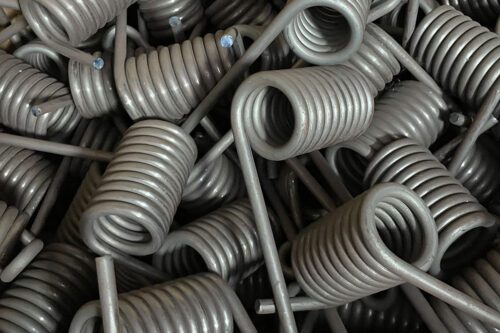
When durability, strength, and cost-efficiency are essential, oil tempered springs are a go-to solution for many mechanical and industrial applications. These springs are made from oil tempered wire, a heat-treated material known for its balance of strength, toughness, and fatigue resistance. Ideal for high-load and moderate-cycle applications, oil tempered springs are widely used in agricultural equipment, garage doors, heavy machinery, and more.
At Wermke Spring, we manufacture custom oil tempered springs with precision and consistency. Our decades of experience in spring engineering and material selection allow us to deliver dependable spring solutions that meet your performance and budget requirements. Contact us to learn more or request a quote for spring manufacturing.
What Are Oil Tempered Springs?
Oil tempered MB ASTM A229 wire is a high-carbon steel wire that has been quenched in oil after heating, followed by tempering to achieve a balance of hardness and ductility. This process enhances the wire’s mechanical properties, making it strong, shock-resistant, and fatigue-tolerant. Oil tempered wire has a nominal composition of Carbon 0.55% – 0.85% with a Manganese presence of 0.60% – 1.20%. It is often referred to as “OT”. It is ideal for forming springs that must perform under repeated stress and variable load conditions.
There are two types of oil tempered MB wire: Class 1 and Class 2. Class 1 is used for low stress and static applications. Class 2 wire is typically used where a higher tensile strength is required. Class 1 is more commonly used when electroplating is required because it can reduce the risk of hydrogen embrittlement occurring in higher hardness pre-tempered materials.
Oil tempered springs are often preferred when cost-effective strength is needed, but the environment is relatively dry or protected from harsh corrosion exposure.
Advantages of Oil Tempered Springs
1. High Tensile Strength
Oil tempered springs are designed to withstand significant loads. The tempering process produces a tensile strength in the range of 160,000–300,000 psi, depending on the wire diameter.
2. Excellent Fatigue Resistance
With proper design, oil tempered springs offer reliable performance over many cycles, especially in low to moderate frequency loading environments.
3. Shock and Impact Resistance
Thanks to their tempered microstructure, these springs absorb shock well, making them suitable for rugged mechanical systems and impact-prone assemblies.
4. Cost Efficiency
Compared to alloy or stainless steels, oil tempered wire is more economical while still providing excellent performance. This makes it ideal for applications where corrosion resistance is not a primary concern.
5. Dimensional Stability
The tempering process produces consistent spring back and dimensional uniformity, which supports accurate forming and long-term performance.

Limitations of Oil Tempered Springs
Like all materials, oil tempered wire has certain trade-offs:
1. Poor Corrosion Resistance
Oil tempered springs are not inherently corrosion-resistant. Without protective coatings or treatments, they can rust in humid or corrosive environments.
2. Lower Tensile Strength than Music Wire
While oil tempered springs are strong, they do not match the tensile strength of music wire springs and are not suitable for extremely high-stress applications.
3. Surface Finish
The surface of oil tempered wire is rougher than that of music wire, which can increase stress concentrations and reduce fatigue life if not addressed in design.
4. Temperature Limits
Oil tempered wire performs best below 250°F (121°C). Elevated temperatures may degrade its mechanical properties.
Common Applications for Oil Tempered Springs
Oil tempered springs are found in a wide range of mechanical systems where durability and affordability are key:
- Garage Door Springs: Torsion springs for residential and commercial overhead doors
- Agricultural Equipment: Heavy-duty compression springs in suspension systems, tines, and hoppers
- Industrial Machinery: Shock-absorbing components in presses, conveyors, and crushers
- Automotive: Leaf spring inserts, brake springs, and suspension-related components
- Construction Equipment: Extension springs for load-bearing and vibration-absorbing parts
Types of Oil Tempered Springs We Manufacture
Wermke Spring offers fully custom oil tempered spring solutions in the following configurations:
- Compression Springs – Provide axial load support with stable deflection and rebound
- Extension Springs – Deliver consistent return force in tension-loading applications
- Torsion Springs – Used in rotary motion systems requiring torque and stability
- Wire Forms – Custom bent geometries for brackets, clamps, and linkages
Every spring is manufactured to meet precise force, deflection, and dimensional specifications, with optional coatings to enhance environmental resistance.
Frequently Asked Questions
What’s the difference between oil tempered wire and music wire?
While both are types of high carbon steel springs, music wire is cold-drawn and offers higher tensile strength and a smoother surface finish, making it ideal for high-performance, high-cycle applications. Oil tempered wire is heat-treated and better suited for heavy-duty, low to moderate-cycle usage where corrosion resistance is not a primary concern.
Can oil tempered springs be used outdoors?
Only if protected. Oil tempered springs must be coated with zinc, paint, or other corrosion-resistant finishes to perform well in humid or corrosive environments.
How long do oil tempered springs last?
Lifespan depends on application conditions, but when properly designed, oil tempered springs can last for thousands to tens of thousands of cycles in suitable environments.
Are oil tempered springs magnetic?
Yes. Oil tempered wire is ferromagnetic and not suitable for applications requiring non-magnetic performance.
Can Wermke Spring provide certifications?
Yes. We can provide full material traceability and certification upon request, including compliance with ASTM A229 and other relevant standards.
Engineering Considerations
When engineering oil tempered springs, it’s important to evaluate:
- Operating environment – Moisture exposure requires protective finishes
- Stress profile – Avoid overstressing or exceeding the elastic limit for optimal fatigue life
- Coating requirements – Plating or painting extends service life and improves appearance
- Heat sensitivity – Keep within recommended temperature range for stability
Our engineers help you select the best wire gauge, coil configuration, and finishing options based on your specific application.
Why Choose Wermke Spring for Oil Tempered Springs?
At Wermke Spring, we understand how to leverage material properties and engineering best practices to deliver dependable oil tempered springs that perform in real-world conditions. Our state-of-the-art equipment, skilled technicians, and quality assurance processes ensure you get high-performance springs at a competitive price.
We offer:
- Custom spring engineering and prototyping
- Tight-tolerance forming and heat control
- Surface treatments for enhanced performance
- Fast lead times and dependable delivery
Contact Us Today
Need custom oil tempered springs designed for your equipment? Call Wermke Spring at (636) 677-5500 or contact us online to request a quote or speak with an expert. We’re ready to support your project with springs engineered for strength, value, and reliability.