As an industry leader in precision spring manufacturing, Wermke Spring is committed to educating our customers and supporting informed decision-making. Whether you’re an engineer looking for tight-tolerance solutions, or a buyer sourcing springs for high-performance applications, the answers below address some of the most common questions we receive about spring engineering, materials, testing, and reliability.
To learn more or request a quote for spring manufacturing to meet your precise specifications, contact us online or by phone today.
General Spring Manufacturing Questions
What is the best spring material for my application?
Choosing the right material depends on the application’s environment, load requirements, temperature range, and cost considerations. Here’s a quick reference:
- Music Wire – High tensile strength, great for dry indoor uses
- Stainless Steel (302, 304, 316, 17-7) – Corrosion-resistant, suitable for food, medical, and outdoor applications
- Chrome Silicon – High fatigue and temperature resistance; used in automotive and heavy-duty systems
- Inconel, Elgiloy, Hastelloy – Ideal for high-temp and corrosive environments
- Phosphor Bronze & Beryllium Copper – Conductive, non-magnetic, and corrosion-resistant
Wermke Spring engineers will help select the right spring material based on your exact performance criteria.
Learn more about our custom spring manufacturing capabilities.
How do I select the right spring type for my application?
Begin by determining:
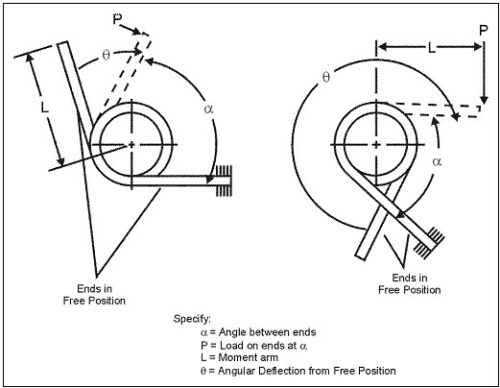
- Type of force: compression, extension, torsion
- Required load or torque
- Available installation space
- Environmental conditions (temperature, corrosion, etc.)
- Expected cycle life
Based on these inputs, we’ll help you engineer or select a spring that delivers optimal performance, longevity, and cost-efficiency.
Learn more about how to avoid common spring design and manufacturing mistakes.
What is residual stress and how does it affect spring performance?
Residual stresses are internal stresses introduced during manufacturing (e.g., coiling or forming). If not properly relieved through heat treatment, these stresses can cause spring distortion, reduce fatigue life, or lead to failure. We perform stress-relief and shot peening to manage and reduce residual stress, improving spring reliability and cycle life.
Learn more about common spring terminology and definitions.
Spring Design and Engineering Questions
What are standard tolerancing guidelines for spring manufacturing?
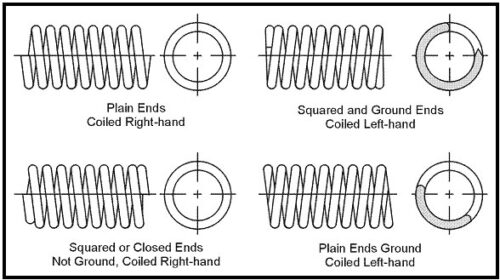
Tolerances are based on wire diameter, coil count, and free length. We adhere to the Spring Manufacturers Institute (SMI) standards unless otherwise specified. For example:
- Wire diameter: ±0.001–0.003 inches (depending on size)
- Outside diameter: ±0.005–0.015 inches
- Free length: ±0.03–0.125 inches
- Spring rate: ±10% standard, tighter upon request
Custom tolerances are available for critical components.
Learn more about how we can meet your spring design specifications.
What is spring index and why does it matter?
The spring index is the ratio of the mean coil diameter to the wire diameter (D/d). A spring index between 4 and 12 is ideal. Low indices (<4) make springs harder to form and more prone to internal stresses, while high indices (>12) may cause instability or buckling.
How is fatigue life determined in spring design?
Fatigue life depends on the stress range, material type, surface condition, and number of cycles. Our engineers use Goodman or Soderberg diagrams and FEA (Finite Element Analysis) to optimize fatigue performance. Surface treatments like shot peening and proper stress-relief significantly increase spring durability in high-cycle applications.
What is solid height, and why is it important?
Solid height is the fully compressed length of a spring when all coils are touching. Springs should be designed to avoid reaching solid height under normal use, as this can cause overstressing, distortion, or permanent set.
Spring Testing and Quality Assurance
How are springs tested for quality?
At Wermke Spring, we utilize several quality control methods, including:
- Load testing: Verifying force or torque at specified deflections
- Dimensional inspection: Using precision measurement tools
- Material certification: Verifying material composition and properties
- Visual inspection: Identifying surface defects or irregularities
All testing is documented and traceable for quality assurance and compliance.
Learn more about our industrial spring quality testing services.
What certifications can you provide?
We provide material certifications, dimensional inspection reports, and first article inspection (FAI) documentation upon request. Certifications can comply with ASTM, ISO, MIL-SPEC, or customer-specific standards.
What surface finishes are available for springs?
To enhance corrosion resistance or fatigue life, we offer:
- Zinc plating
- Nickel or chrome plating
- E-coating (electrophoretic painting)
- Black oxide
- Powder coating
- Electropolishing (for stainless steel)
- Passivation
- Shot peening (to improve fatigue life)
Application-Specific Questions
Can you reverse engineer a spring from a sample?
Yes. We regularly reverse engineer springs from worn, broken, or undocumented parts. By analyzing dimensions, wire type, and coil geometry, we can replicate and improve your existing spring.
Do you manufacture springs in small or large volumes?
We offer both low-volume custom spring production and high-volume manufacturing. Whether you need one spring for a prototype or thousands for OEM assembly, we deliver consistent, high-quality results.
What’s the difference between hot-wound and cold-wound springs?
- Cold-wound springs: Formed at room temperature from smaller diameter wire; ideal for precision components
- Hot-wound springs: Coiled from bar stock heated to 1500°F+; used for large, high-load industrial springs
We specialize in cold-wound springs, offering exceptional precision and repeatability.
What’s the lead time for custom springs?
Lead time depends on material availability, complexity, and volume. Standard orders often ship within 2–4 weeks. Expedited services may be available for urgent jobs.
Trust Wermke Spring for Your Custom Spring Needs
At Wermke Spring, we don’t just manufacture springs – we engineer solutions. Our team of experts provides design consultation, material guidance, and manufacturing support for everything from high-cycle compression springs to corrosion-resistant wire forms.
Whether you’re designing a new product, troubleshooting a fatigue failure, or sourcing high-quality springs for production, we’re here to help.
Have more questions about spring manufacturing or engineering? Call Wermke Spring at (636) 677-5500 or reach out online to speak with our team. We’re ready to support your next project with expert guidance, quality products, and a commitment to your success.