When it comes to rotational force and angular motion control, torsion springs are a go-to component in countless mechanical systems. While all torsion springs share a common operating principle – storing and releasing energy through twisting – not all torsion springs are the same. In fact, there are two main torsion spring types: single and double torsion springs. Beyond that, there are numerous ways to customize torsion springs to meet specific load, space, and application requirements.
At Wermke Spring, we manufacture custom torsion springs for a wide range of industries including automotive, aerospace, industrial equipment, medical devices, and consumer products. This guide explores the fundamental torsion spring types, leg configuration options, and how these variations impact performance. To learn more or request a quote for torsion spring manufacturing, contact us today.
What Is a Torsion Spring?
A torsion spring is a helical spring designed to resist or apply a torque when its ends are rotated around the spring’s axis. These springs store rotational energy and release it to return to a neutral position.
The torque output of a torsion spring can be calculated using:

Where:
- T = torque (in-lb or N·mm)
- k_t = torsional spring rate (in-lb/deg or N·mm/deg)
- θ = angular displacement (degrees or radians)
Learn more about: What Are Torsion Springs?
The Two Main Torsion Spring Types
1. Single Torsion Springs
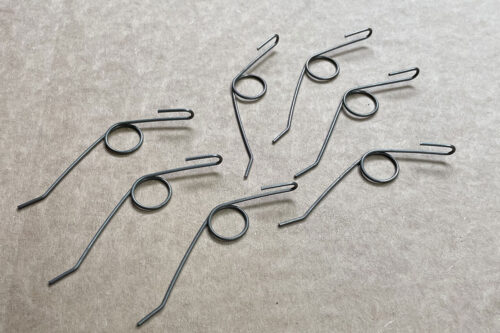
Single torsion springs consist of one set of coils wound in a helical shape with legs extending from each end. As torque is applied, the spring exerts a force in the opposite direction of the twist. The torque capacity and deflection depend on the spring’s coil diameter, wire diameter, number of coils, and leg configuration.
Key Characteristics:
- Most common type
- Available in left-hand or right-hand wind
- Customizable leg shapes
Applications:
- Vehicle hoods and latches
- Hinges and door systems
- Switches and levers
2. Double Torsion Springs
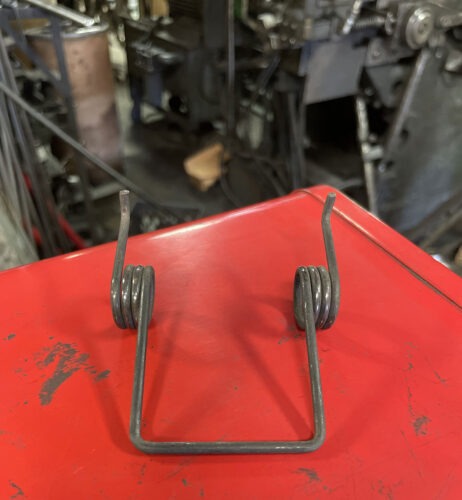
Double torsion springs are made up of two single torsion springs wound in opposite directions and connected by a central section. The coils are connected and work together to provide greater torque and stability in applications where symmetrical force is needed or where two components rotate in opposite directions.
Advantages:
- Higher torque capacity
- More balanced operation
- Can function in opposing directions simultaneously
Applications:
- Counterbalance mechanisms
- Industrial actuators
- Safety locks and mechanical arms
Torque Calculation: For double torsion springs, each side contributes torque. Total torque is the sum of torque generated by each coil set, assuming equal leg deflection:
Torsion Spring Leg Styles and Configurations
While there are only two primary torsion spring types, much of their versatility comes from the way the legs are shaped, oriented, and positioned. Custom leg configurations ensure the spring fits and functions correctly within the assembly.
Common Leg Styles:
- Straight Legs – Extend tangentially from the body, often used in general applications.
- Axial Legs – Extend parallel to the spring axis, minimizing space usage.
- Offset Legs – Bent at an angle to align with adjacent components.
- Hooked or Loop Ends – Used to anchor the spring in a fixed position.
- Custom Formed Legs – Designed to fit proprietary housings or mechanisms.
Leg Angle Options:
Legs can be designed to rest at a variety of free angles, the angle between the legs when the spring is unloaded. Common default angles include 90°, 180°, or 270°, but custom angles can be manufactured for exact fit and preload requirements.
Wind Direction: Right-Hand vs. Left-Hand Torsion Springs
The direction of the spring wind affects how torque is applied and absorbed. Choosing the correct wind direction is crucial for proper performance and to prevent failure.
- Right-hand wound springs coil clockwise
- Left-hand wound springs coil counterclockwise
The direction must match the rotational direction of the applied load.
Choosing the Right Torsion Spring for Your Application
When selecting or designing a torsion spring, factors to consider include:
- Required torque and angular deflection
- Space and mounting constraints
- Environmental factors (temperature, corrosion, vibration)
- Leg orientation and resting angle
- Cycle life and fatigue requirements
Wermke Spring provides engineering assistance to evaluate each factor and recommend or produce a torsion spring that performs reliably under your application’s specific conditions.
Frequently Asked Questions About Torsion Spring Types
Are there different types of torsion springs?
Technically, there are two main torsion spring types: single and double torsion springs. The variety within torsion spring design mostly comes from custom leg styles, free angles, and application-specific configurations.
What materials are best for torsion springs?
Music wire, stainless steel (302, 316, 17-7), and chrome silicon are commonly used. The best choice depends on environment, fatigue requirements, and torque demands.
Learn more about Torsion Spring Materials
Can you make torsion springs with custom legs?
Yes. We manufacture torsion springs with fully customized leg shapes and lengths to fit specific mechanisms or design envelopes.
What’s the maximum angle a torsion spring can twist?
That depends on the wire material, diameter, number of coils, and load. We work with customers to define safe maximum deflection and avoid overstress.
Can a torsion spring operate in both directions?
Standard single torsion springs are designed to work in one direction. Double torsion springs are capable of handling rotation in opposing directions.
Trust Wermke Spring for Custom Torsion Spring Manufacturing
Wermke Spring has been a trusted spring manufacturer since 1953. We offer full-service support for custom torsion springs, including engineering assistance, prototyping, and production. Whether you need a standard single torsion spring, a double configuration for added torque, or custom leg ends for tight installation areas, we have the expertise to deliver precision, performance, and quality.
We serve clients across industries, including automotive, aerospace, industrial, medical, electronics, and support both small batch and high-volume production.
Contact Us Today
Need help selecting from available torsion spring types or designing the right spring for your project? Call Wermke Spring at (636) 677-5500 or contact us online to get expert guidance, request a quote, or start your next spring solution. We’re here to help you make the right choice for torque, performance, and reliability.