

Compression springs are open-coil helical springs designed to resist a compressive force applied along the axis of the wind. They are one of the most common and versatile types of springs used across nearly every industry, from automotive and aerospace to medical devices and industrial equipment. Read on to learn more about what compression springs are and other important information.
At Wermke Spring, we specialize in manufacturing precision compression springs for a wide variety of applications. Our team works closely with engineers, purchasing teams, and OEMs to ensure each spring meets exact load, deflection, and dimensional specifications. To learn more or request a quote for your spring manufacturing needs, contact us online or by phone today.
Understanding the Function and Design of Compression Springs
So what is a compression spring? A compression spring stores energy when compressed and releases that energy when the force is removed. It pushes back against the applied load and returns to its original length when the load is released.
Compression Spring Characteristics
- Shape: Typically cylindrical, but can also be conical, barrel-shaped, or hourglass-shaped
- Ends: Options include open, closed, ground, or square ends depending on the application
- Load and Deflection: The force a spring exerts and the amount it compresses under that force
The performance of a compression spring is defined by several critical factors:
Spring Rate (k): The amount of force required to compress the spring by a unit of distance.
Expressed as:

Where:
- k = spring rate (N/mm or lb/in)
- F = force applied (N or lbs)
- x = deflection (mm or in)
Hooke’s Law also applies:

This law governs linear elastic behavior and is fundamental to spring design.
Types of Compression Springs
Compression springs can be manufactured in several shapes and styles, depending on the required performance and spatial constraints:
Cylindrical Compression Springs
The most common type, with a constant diameter throughout. Used in general-purpose applications.
Conical Compression Springs
These taper to a point and are ideal where space is limited. They also reduce the possibility of buckling.
Barrel and Hourglass Springs
Shaped to distribute stress more evenly or provide a specific force profile. Often used in automotive or aerospace applications.
Nested Compression Springs
Springs placed inside each other to increase force within a compact space. Used in high-load applications.
Learn more about Types of Compression Springs
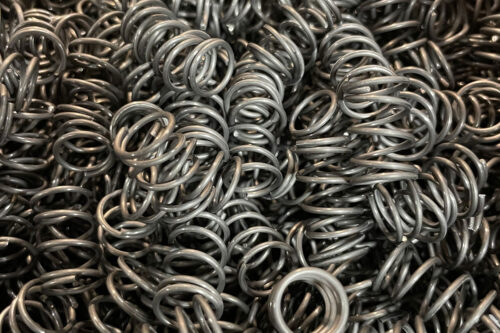
Compression Spring Materials
The material used for a compression spring significantly affects its performance, life span, and suitability for specific environments. At Wermke Spring, we offer compression springs in:
- Music Wire – High tensile strength, ideal for static applications
- Stainless Steel (302, 316) – Corrosion resistant and suitable for medical, food, and outdoor uses
- Phosphor Bronze & Beryllium Copper – Excellent conductivity for electrical applications
- Chrome Silicon – High strength and temperature resistance for automotive and heavy-duty industries
- Inconel & Elgiloy® – High-performance alloys for extreme environments
Learn more about Compression Spring Materials
Applications and Industry Uses
When learning what compression springs are, it is important to consider common applications and uses. Compression springs are used in an extensive range of products and industries:
- Automotive: Suspension systems, valves, seats, and braking mechanisms
- Aerospace: Actuation systems, control surfaces, and engine components
- Medical Devices: Syringes, surgical instruments, and drug delivery systems
- Industrial Equipment: Valves, actuators, and vibration dampening systems
- Consumer Products: Pens, battery compartments, and push-button devices
These springs are often selected for their ability to store mechanical energy and apply consistent force in compact spaces.
Frequently Asked Questions
What are the key specifications needed to design a compression spring?
Key specifications include wire diameter, outer diameter, free length, solid height, number of active coils, spring rate, and material type. Providing these allows our team to help engineer for force, deflection, and fatigue resistance.
How do I determine if a compression spring will fit my application?
We recommend submitting performance requirements (load, deflection, space constraints) along with environmental conditions. Our engineering team will assist with selecting the right geometry and material.
Can Wermke Spring manufacture small or micro compression springs?
Yes. We regularly produce springs with extremely small wire diameters for precision applications, including electronics and medical devices.
Do you provide prototypes or low-volume runs?
Absolutely. We offer prototyping and short production runs for testing and validation before full-scale manufacturing.
Trust Wermke Spring for Expert Compression Spring Manufacturing
Wermke Spring combines technical expertise with more than 70 years of manufacturing experience to deliver high-performance compression springs for even the most demanding applications. From one-off prototypes to millions of production units, we provide engineering support, material guidance, tight tolerance control, and responsive service every step of the way.
Whether you need a standard cylindrical spring or a custom configuration for a unique project, we can deliver the precision, quality, and consistency your application requires.
Contact Us to Learn More About What Compression Springs Are & More
If you’re looking for a reliable compression spring manufacturer, contact Wermke Spring today. Call us at (636) 677-5500 or reach out online to speak with our team, request a quote, or discuss your spring design needs. We’re here to help you find the best spring solution for your project.